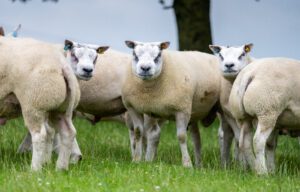
Having had a clear focus on breeding low maintenance flock replacements since his first pedigree purchases as a young man, well-known breeder and showman Andrew Baillie has continued to concentrate on the commercial traits of the Beltex, which he says have been improved considerably over the years.
Now, some 20-plus years on from the establishment of his Callacrag prefix, his pedigree Beltex, together with crossbred and pedigree Texels, share a low input leader-follower rotational grazing system on his family’s sheep and dairy holding at Carstairs Mains in Lanarkshire. While Callacrag offerings have made some notable prices in breed society fixtures, sales of both tups and females to commercial lamb producers, are also an important part of the business.
Carstairs Mains in South Lanarkshire runs to some 240ha, the majority of which under grass but with a rotation of wholecrop wheat for ensiling, 15ha of barley plus forage crops. There is also about 70ha of woodland. When the farm was first acquired it had been a dairy unit but with considerable investment needed to bring it up to standard, the Baillies just ran sheep and suckler cows for many years. However, four years ago, in partnership with his brother who already had Jersey dairy cows, the investment was made in dairy building and equipment, and the sucklers were sold off.
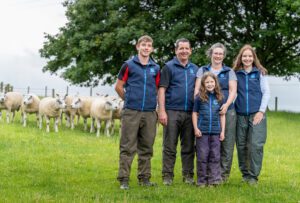
While the dairy enterprise is in partnership, the rest of the farm is run by Andrew and wife Jennifer, along with their three children, Rachel who is studying at Harper Adams, Cameron who is at home and has established his own Carstairs Beltex prefix, and younger daughter Lauren who is still at school.
Maintaining a pedigree flock of Beltex is at the core of the sheep enterprise but this is integrated with around 100 pedigree Texels to breed the 50 or so Texel Beltex crosses for commercial lamb production.
Says Andrew: “I have always been a sheep farmer and we have always enjoyed showing both pedigrees and commercials and I have to say we have been pretty successful with both. However, while showing helps promote our stock, it is sales which provide the income. We would aim to produce around 100 shearling tups to sell each year, the majority pedigree Beltex but also pure Texels and approximately 35 cross-breds and our main sales are Kelso, Carlisle, Lanark and Stirling.
“I am in no doubt that as a breed, the Beltex has been improved over the 30 years or so they have been in the UK and that is without losing the tremendous conformation, but at the same time increasing length and scale, and certainly in our case, functional correctness and reduced maintenance. Our finished lambs are all sold liveweight, not least because Lanark market is virtually on our doorstep. With our commercial flock lambing in April, we will have lambs away at good weights off grass by the beginning of December. We take three cuts of silage for the dairy herd and so from early August we have some 50 acres of foggage available. I think that weight certainly pays in the live market and our lambs will be away at about 45kg.”
“All our commercial ewes are served with Beltex tups. I can’t see any other breed which can compete with the Beltex. Some might be faster growing, but it depends on your system and the cost of getting that growth, and the Beltex killing out percentage is phenomenal. We are getting it all pretty much from just forage.”
The pedigree ewes lamb from late February into March having been wintered on forage crops — hybrid kale and stubble turnips — as are all the sheep. No supplementary feed is given pre-lambing but they do lamb inside and get a total mixed ration based on high quality silage and then a small amount of concentrate until the grass comes through. From then onwards,rotational grazing is practiced and on this system, the sheep are moved every two days, so getting the best grass, and the in-calf dairy heifers follow on.
Says Andrew: “I think it is very important when we are selling to both pedigree breeders and commercial sheep farmers, that we can offer low maintenance stock and it is for that reason I have done quite a lot of work on mastitis and lambing ease.
“I keep detailed records using a Shearwell recording system, and have amassed quite a lot of data to the point that we are now able to only select flock replacements from females which have been at least two generations mastitis free and this does seem to be working. I use the California MastitisTest for our ewes, as in dairying, and we do not keep any which record a high somatic cell count and within just one year, cases dropped dramatically. For any that do a record a higher scc, I can look back and see it in their grand dams and so it is a gradual process but well worth it.
“Similarly with lambing ease, I score all the ewes at lambing time and any with a tight pelvis recording a low score. Fortunately we do not have foot problems here, but we do vaccinate and footbath regularly.
“As mastitis can be a hereditary issue, I can confidently tell potential tup buyers at the sales that they are bred from at least two generations mastitis free. And when people are looking at our tups in the pens, I also like to be able to tell them which are going to be best as maternal sires.”
Like most pedigree breeders, Andrew makes judicious use of ET, but says he would never flush a ewe which had had mastitis.
“I like to think that my breeding of good, commercially sound, larger framed Beltex is being reflected in our sales. Last year, I had a personal 18,000gns record at Carlisle for a shearling, Callacrag Jesus, and also our best overall average yet from all the sales we attended for about 70 tups, of 1,400gns. Everything we sell which are not pedigree, go through Lanark auction.”
The popularity of the Beltex in the UK, has also caught the attention of New Zealand sheep farmers and Andrew says the majority of their Beltex genetics originated from Callacrag.
Says Andrew: “It began when a New Zealand sheep scientist looking at the potential to improve carcase traits there, made contact with me as I was also Signet recording, and then he came over to carry out some of his own research.
“To cut a long story short, it was probably about eight years ago, I began to do some flushing for him and continued over the next four years and would send between 50 and 100 embryos each time, plus some semen. Since then we have also sent genetics to Switzerland.”
Much closer to home, the Callacrag flock has had several notable and well documented wins over the years at shows in Scotland including, not least, the supreme sheep championship at the 2025 Royal Highland with commercials — a three crop cross-bred ewe with her twin Beltex sired lambs. The ewe was Beltex sired by Wannops Firecracker and out of a Texel dam while her lambs were by the Baillie’s own Callacrag Krist. Past wins have also included a male championship at the Highland, plus regular placings at the Scottish Winter Fair, AgriExpo and LiveScot.
“While showing is important and something we all enjoy, genetic gain comes from breeding off not necessarily show winners, but as I have already said, the best females and tups which are good, functionally correct animals with low maintenance requirements.”
Farmer Andrew Bailey and his sheep
Farmer Andrew Bailey and his sheep
Farmer Andrew Bailey and his sheep
Farmer Andrew Bailey and his sheep

